HDR stands for High Dynamic Range. Dynamic Range, for our purposes, is the amount of information a sensor can record between the points where the sensor renders input as white and where the sensor renders input as black in any given scene. Dynamic Range is measured in f/stops, so, for example, my Canon 5d2 has a dynamic range of nearly 12 stops. Now, imagine a scene partly in shadow and partly in sun. A 12 stop dynamic range means I could record at least some detail in the shadow and some detail in the bright part of the image, even if the bright part of the image was 4096 times brighter than the shadow part.
When there’s more than 12 stops difference between the light and dark areas of a scene, I must choose to expose for either the bright part or the dark part. If I choose to expose for the dark part, the part that’s more than 12 stops brighter will turn to white, or be blown out, as we say. If I choose to expose for the light part, the part that’s more than 12 stops darker will turn to black, or be blocked up, as we say.
This is a problem photographers once solved with filters; graduated neutral density filters had a dark half and a light half. Block some light from the bright part of your image and now you’re back within the dynamic range your camera can handle. You could also do this with just a black piece of paper, removing part-way through an exposure. When Photoshop first introduced layers, photographers sometimes handled this problem by blending the properly exposed parts of two images together to make one properly exposed image.
Now, as you might start to understand, all photography is actually LOW dynamic range. The whole point of filters and black paper and photo blending is to take the high dynamic range of the natural world and compress it down to a low enough dynamic range that our cameras and printers and papers can handle.
Then came “HDR photography”. The term came to be applied to photography created via tone-mapping by software like Photomatix. Tone-mapping means taking one set of colors or tones and mapping them onto another. Take a look at the picture on Photomatix’s home page:
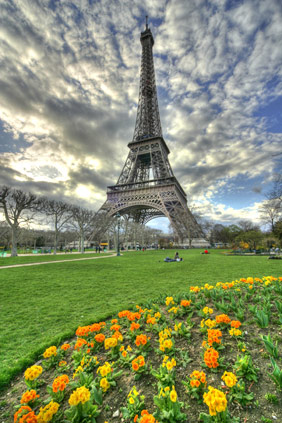
Notice that there’s not a big difference between the lightest part of the scene and the darkest? Look at the dirt beneath the flowers. Have you ever seen a flower bed where the dirt is as bright as the flowers? Nope. How about the weird trees on the left that have strange dark areas around the tops? That doesn’t look right either. What about the clouds with their strange dullness, even though you apparently have dark parts next light parts (but no contrast?!)
That’s why I hate “HDR” as it’s known. Not because I demand photos to render scenes as accurately as possible, lord knows that’s not my goal, but because I like photos to either render scenes beautifully, or powerfully, or emotionally, or artistically; not weirdly or garishly. Doesn’t that dirt just make the scene look like it’s some sloppy stage background? Nothing jumps out at me! Everything’s flat and even and boring! Where’s the subject? Where’s the drama!? I feel like I’m taking crazy pills. Ugghh.
I guess I’m in the minority though, because the public seems to eat this shit up. So, if you like this stuff, if you’re making money selling it, more power to ya. But I still hate it.
 .
.
While I agree that the way many people use the technique is not appealing and that it can easily lead to a look that just feels “off”, I don’t feel that it’s inherent to either merging bracketed exposures or to tonemapping them.
If you take a look at the first two examples from one of my blog posts earlier this year (sorry that the site is still in transition, it’s been hectic), Windermere Ranch (First Shoot) you can see that there are definitely still shadows and that the first example (though not the second) does not have particularly garrish colors. Even the third one (which I still have a lot of issues with) preserves some of the shadows, and I believe that good HDR work needs to remember to do that.
What the HDR was used for in those cases, was to capture as much detail in the clouds as possible while not leaving the rest of the scene entirely black, not to “equalize” the entire dynamic range to the point of lacking interest.
Anyway, the examples were tonemapped with another package (not Photomatix Pro) but I feel like it’s worth examining the extent to which the unfortunate way the process often gets used is actually intrinsic to the process.
omg, i hate hdr too! i was googling i hate hdr cos i dont see the point of unrealistic photos myself. thanks for the deserved argument.
Yes, I agree. Mostly because many look unrealistic if not cheap (and at times – like crap altogether). It turns a marginally good medium (digital) into something unsavory. I think in a few years, the warm glow will diminish and public opinion will look less favorable upon HDR as a style. Kinda like the Sepia toned image trend of the last 10 years. Hopefully these (HDR’d) images won’t dull people’s senses too much before order is restored… 😉